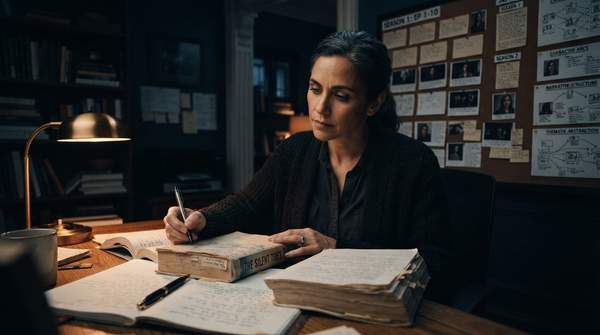
The showrunner has always been television's boss, but streaming has turned the job into something closer to running a company. In the traditional broadcast model, the role centered on creative authority—shaping the story and answering to the network. In the streaming era, the same title now carries expanded managerial and business duties, from staffing and budgeting to negotiating with platform executives, while the career ladder that once produced showrunners has been significantly disrupted. Here is how the role evolved, and what changed for the writers hoping to climb into it.
The Showrunner: Creative Authority in Television
Strip away the industry jargon and the definition is straightforward. Writer Alex Epstein, in his book and blog Crafty Screenwriting, defines the showrunner as "the person responsible for all creative aspects of the show and responsible only to the network (and production company, if it's not [their] production company). The boss. Usually a writer." Traditionally, the executive producer of a television program served as the chief executive, responsible for the show's creative direction and production.
What that means in practice, as film-industry writer Jourdan Aldredge explains, is that the showrunner is "the key individual (or individuals) responsible for nearly every aspect of your favorite program." Viewers may know directors and actors by name, but the showrunner is the single most important person behind a television or streaming title—the figure whose vision governs what appears on screen.
Traditional Broadcast Model: A Clear Path
Under the traditional network system, the showrunner's authority was creative first, managerial second. The role combined creative initiative with management duties like staffing and budgeting, but the writer's path into it was well established. Writers entered through the writers' room, stayed on payroll throughout production of a full series, and accumulated on-set experience season after season. That continuous involvement was the apprenticeship system of American television: a writer could watch a show being made, learn production from the inside, and gradually acquire the practical experience the top job demanded.
Streaming's Ascent: Expanding Responsibilities
The rise of streaming platforms broadened the job itself. As industry commentary on the showrunner-as-auteur notes, the role now "combines corporate management—sometimes the showrunner is called the CEO of a TV show—and creative initiative." Beyond being storyteller-in-chief, the modern showrunner staffs the show with writers, negotiates with network executives, and handles budgeting. The expansion reflects the increased scope and demands of streaming production, where a single person must coordinate creative vision with the business machinery of a global platform.
The marketplace changed too. Streaming platforms expanded showrunner opportunities beyond the traditional networks: multiple distribution channels mean more series requiring creative leadership, creating pathways for emerging talent that simply did not exist when a handful of broadcasters controlled the industry.
Showrunner Role: Traditional vs. Streaming Model
The table below juxtaposes the two systems across the dimensions where the evidence shows the clearest shifts—in responsibilities, production cycle, career path, and marketplace dynamics.
| Dimension | Traditional Broadcast | Streaming Model |
|---|---|---|
| Key Responsibilities | Primarily responsible for all creative aspects of the show, reporting to the network and production company; management duties like staffing and budgeting accompany the creative lead. | Expanded into corporate management—often called the "CEO of a TV show"—encompassing staffing, negotiation with executives, and budgeting alongside creative initiative. |
| Production Cycle | Full series production with writers typically remaining on payroll throughout, allowing continuous involvement and on-set experience. | Writers often work well in advance of production and may be off payroll before it begins; "mini rooms" reflect cost-cutting in the vertically integrated streaming delivery model. |
| Career Path | A traditional ladder from the writers' room, with gradual accumulation of production experience through on-set involvement. | The ladder is disrupted, with fewer opportunities to gain on-set experience; the model favors "unique voices" and distinctive perspectives. |
| Marketplace Dynamics | Limited to a small number of traditional networks as the primary buyers of series. | Multiple distribution channels and more series requiring creative leadership, expanding demand for showrunners and pathways for emerging talent. |
The 'Binge-Watch' Effect on Production
The mechanism behind the disruption is the delivery model itself. Entertainment attorney Brian J. Murphy, writing on streaming's impact, observes that the streaming of motion picture content and the binge-watching model of dropping all series episodes at once have changed how Hollywood writers typically create—requiring them to work well in advance of production and on more than one series in a twelve-month cycle. The "mini room" is the emblematic practice: a small writers' room that scripts a season before cameras roll, after which writers may be removed from payroll well before production begins. It is a cost-cutting measure rooted in the vertically integrated streaming delivery system.
Disrupted Career Ladders for Aspiring Showrunners
The consequence is a shortage of the experience the job requires. According to veteran showrunner John Wells, a former president of the Writers Guild of America West, "There simply isn't the opportunity to get the experience you need." Writers who once learned production by being present for it now finish their scripts and leave, moving to another series in the same cycle without ever seeing their words filmed.
Yet the same shifts have opened doors that did not exist before. According to Hrishi Desai, partner and co-head of the literary department at ICM Partners, "The rules have changed because of the era we're in. There is an emphasis on voices and people with really unique perspectives who are on the ascent to being showrunners." Aspiring creatives can showcase their talents in content marketplaces that reward distinctive perspectives, even as conventional pathways for gaining experience are continually reduced.
The Showrunner as 'CEO of a TV Show'
Put the pieces together and the modern job description comes into focus. The streaming-era showrunner is simultaneously storyteller-in-chief and corporate manager: hiring the writing staff, negotiating with the platform, controlling the budget, and delivering a finished season to a global audience. The "CEO of a TV show" label is not a metaphor for ego but a description of scope—one person accountable for nearly every aspect of a program, from concept to final delivery, across a production cycle that compresses years of work into advance-scripted, all-at-once releases.
Adapting to the Evolving Showrunner Landscape
Aspiring showrunners and industry professionals must adapt to the expanded managerial and business demands of the streaming model, recognizing the altered career progression paths. The evidence here is industry commentary and observation rather than proprietary production data, and it describes the U.S. television context. The tension to watch is the one the sources themselves frame: streaming has raised demand for showrunners while dismantling the apprenticeship that prepared writers for the role. The measurable indicators of how the industry resolves it are increased demand for showrunners with diverse business acumen and a shift in entry-level writer development programs—developments that will show whether television rebuilds its ladder or replaces it with something new.
Sources
- Client Challenge — SCRIBD
- Streaming Has Created a Showrunner Problem - Brian J. Murphy
- Breaking Down the Multifaceted Role of a Showrunner — The Beat: A Blog by PremiumBeat
- Showrunner - Wikipedia — EN