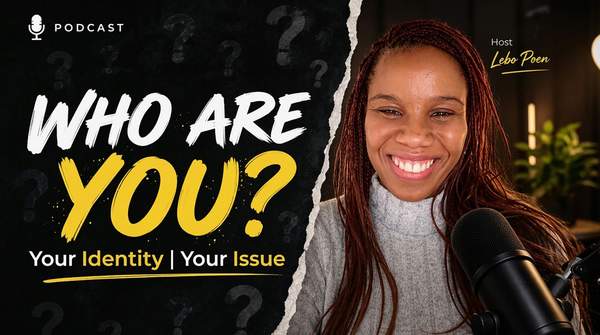
On Lebo Poen’s Who Are You? Your Identity | Your Issue podcast, conversations about identity extend into sport, generations, masculinity, mentorship and creative work. These subjects offer different starting points for thinking about the identities people acquire, enjoy, resist and sometimes outgrow.
When a Compliment Becomes an Assignment
Consider the child who is repeatedly called mature for their age. At first, the praise feels good, and adults may trust them with responsibilities that other children do not receive. Over time, being ‘the responsible one’ can make ordinary mistakes feel like a public failure rather than something everyone is allowed to make.
The same pressure can follow more flattering labels into adulthood. The talented colleague is expected to deliver without help, the funny friend feels obliged to lighten every gathering and the strong family member may be the last person anyone thinks to comfort. None of these descriptions is necessarily false; the problem begins when the description leaves no room for a person’s changing needs.
It can be difficult to challenge a label because doing so changes an arrangement that other people have come to rely on. If you have always solved a group’s problems, stepping back may surprise people who have never thought that you might want a different role. That reaction reveals how much a personal identity can be shaped by the expectations surrounding it.
What Happens When the Game Ends?
Sport can give someone a community, a schedule, a sense of competence and years of memories. An athlete might feel completely at home in the rituals of training and competition, and that identification can be a source of genuine pride. There is no reason to dismiss a role simply because it is important.
The difficult question comes when that role changes. A competitive career can end, an injury can interrupt plans or a once-central activity can gradually become one interest among many. Someone who has spent years answering ‘I’m an athlete’ may need time to discover how they want to introduce themselves next.
‘Beyond the Game: Identity and Impact with Jordan Robinson’ is one of the podcast’s episodes, providing a concrete starting point for exploring identity through sport. Its pairing of identity and impact broadens the subject beyond competition results, inviting interest from people who have built a significant part of their lives around a particular pursuit.
The answer to a changing identity need not involve discarding the past. Training, teamwork, commitment and friendships can remain part of someone’s life even when the role of competitor is over. A label may become less prominent while the experiences attached to it continue to shape the person.
This experience extends beyond sport. Someone leaving a long-held profession, stepping away from a leadership position or reconsidering an ambition may face a similar adjustment. The question becomes how to carry forward the experiences that were meaningful without being confined to the title they once supported.
Generations Make Convenient Shortcuts
A few words about a generation can stand in for an entire argument. ‘Gen Z’ may be used to explain someone’s attitude towards work or technology before anyone has asked where they grew up, what opportunities were available to them or what they actually believe. Older generations receive similarly broad descriptions, usually delivered with plenty of confidence.
Generational patterns can be worth studying, but individuals do not experience a historical period uniformly. Two people born in the same year may have grown up in different countries, entered the workforce under different conditions and had radically different access to the internet. Treating them as interchangeable loses the details that make their experiences understandable.
The podcast catalogue includes ‘Beyond Labels: Understanding Gen Z and Beyond’, giving listeners a direct connection to a familiar public conversation. The subject belongs comfortably alongside the show’s wider exploration of identity because generational labels affect how people describe themselves and how others interpret their behaviour.
Sometimes the most revealing response to a generational stereotype is a story that does not fit it. The person telling it does not need to represent everyone their age; the exception is interesting because it reminds us what a broad label cannot settle.
Masculinity and the Cost of Keeping Up a Role
Gender expectations are particularly powerful because people can encounter them long before they have the words to question them. A boy may learn which emotions receive approval, while an adult may feel pressure to appear decisive, successful or unaffected by difficulty. The expectations vary across families and communities, but they can influence what a person feels permitted to show.
Even an admired role can become restrictive when it has only one acceptable version. Accepting some expectations and rejecting others can be a more complicated experience than simply choosing one side of a debate.
With ‘Identity Beyond Masculinity with Georgie Calverley’, the podcast places this subject within its wider range of identity-centred conversations. The episode offers a particular entry point for listeners interested in masculinity, social expectations and the different ways people understand themselves.
One person may find strength in a traditional expectation that another experiences as restrictive. Someone may cherish aspects of a familiar role while questioning the assumption that everyone who shares that identity must behave similarly. Their experiences deserve to be understood individually rather than forced into another set of categories.
People Can Help Us Discover New Roles
The podcast’s ‘Mentorship, Faith, and the Meaning of Being Chosen with Krystal’ connects identity with relationships and belief. Its inclusion widens the conversation beyond roles received in public settings to the more personal ways people may come to understand their responsibilities, purpose and belonging.
Faith can influence how someone interprets a life experience, while mentorship can introduce possibilities that might otherwise remain unexplored. These influences can be deeply personal, and people may understand them differently even when they belong to the same community.
There Is More Work Behind a Visible Identity
A theatre performance offers a revealing contrast between the person everyone sees and the people whose contributions make the event possible. The audience knows the performers onstage, but the experience also depends on technicians managing sound, lighting, timing and unexpected changes. A job that looks invisible from the seats can demand considerable attention and creative judgement.
‘From Script to Soundboard: Live Mixing for Theatre with Heather Augustine’ takes the podcast into this kind of behind-the-scenes work. Its subject introduces a professional experience that may be unfamiliar to listeners who primarily associate theatre with actors and performers.
Backstage expertise rarely receives the same public recognition as an onstage performance, yet it contributes directly to the finished production. The distinction raises an interesting question about how people understand their professional identities when their most demanding work happens outside public view.
It is possible to be proud of a contribution without wanting attention for it. It is equally possible to enjoy recognition while wishing people understood the other work, interests and relationships in your life. Both possibilities complicate the quick introductions we use every day.
The theatre episode also illustrates the range of subjects available in Who Are You? Your Identity | Your Issue. A listener interested in creative work can find a starting point alongside conversations involving athletes, generational identity, masculinity and mentorship. The shared interest in human experience connects subjects that might otherwise belong to entirely different podcasts.
Keep the Labels That Still Fit
Finding yourself beyond labels does not require you to reject every description other people use. You may love being a parent, an athlete, an artist, a member of your generation or someone known for taking responsibility. Those identities can provide connection and purpose, provided you have room to change how you live them.
The next time someone asks who you are, you can give the short answer without mistaking it for the entire story. You can also ask a more interesting question when somebody else introduces themselves: how did that part of their life become important to them, and what else would they like you to know?
For conversations that take these questions beyond familiar labels, listen to Lebo Poen’s Who Are You? Your Identity | Your Issue podcast on Spotify or YouTube.