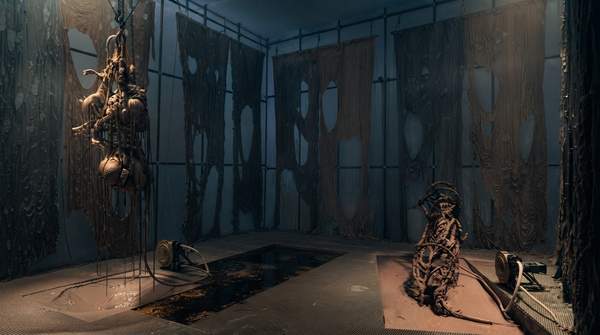
Contemporary artists increasingly treat the material itself as the argument. Anicka Yi floats machine-organisms through museum halls, Theaster Gates excavates derelict Chicago buildings and turns the debris into funding for community institutions, and Erika Iris Simmons unwinds cassette tape into portraits of the very musicians it once carried. Each artist's unconventional medium is inseparable from the theme it explores: the boundary between human and machine, the renewal of urban neighborhoods, and the nostalgia of obsolete media.
Anicka Yi: Blurring Boundaries with Biological Technology
Yi's practice, as the Tate describes it, explores the merging of technology and biology, breaking down distinctions between plants, animals, micro-organisms and machines. Her installations challenge the idea that humans are distinct from other forms of life by blurring these divisions. The studio behind this work is itself a hybrid: she collaborates with philosophers, fabricators, engineers, microbiologists, and perfumers.
The clearest demonstration came with her installation In Love With The World, which populated Tate Modern's Turbine Hall from 12 October 2021 to 6 February 2022 with floating machines she calls "aerobes." The machines are not illustrations of a theme stated elsewhere; they are the theme. By placing synthetic, machine-made objects that behave like living organisms in a cavernous public space, Yi makes the question of what counts as life something visitors physically walk among rather than merely contemplate.
Theaster Gates: Urban Renewal Through Architectural Salvage
Where Yi works at the scale of micro-organisms and machines, Gates works at the scale of buildings and neighborhoods. According to Art21, the Chicago-based artist integrates rust, decay and decomposition into both new works and architectural structures that support communities in his city. His method is unusual in that the material and the economics are fused: Gates purchases properties slated for demolition, then uses the excavated material from those sites to create works of art that fund new projects and ideas, such as the Stony Island Arts Bank.
In Gates' own words, the original building becomes "the thing that makes the thing." The phrase captures his conceptual framework precisely. A derelict structure is not waste but seed capital—its physical fabric becomes art, the art becomes revenue, and the revenue becomes a civic institution. The material carries the history of its site directly into the new institution it finances, making urban renewal something literal rather than metaphorical.
Erika Iris Simons: Media Nostalgia in Recycled Tapes
Atlanta-based artist Erika Iris Simmons, who signs her work with the pseudonym iri5, works with the smallest-scale material of the three: cassette tape. As WebUrbanist reported, her "Ghost in the Machine" series uses cassette tapes to create soulful, richly detailed portraits of musicians and bands—generations of musical legends from Dylan and the Beatles to Kravitz and Nirvana.
The series is described as a physical representation of the ephemeral nature of thoughts and creativity, and the match between medium and subject is unusually tight: the tape that once held the music now forms the face of the musician. Simmons' own account of her beginnings, as reported in Woman's Day, reinforces the point that material choice is the statement. She began experimenting with whatever she could buy for five dollars at Goodwill, inspired by artists "making beautiful portraits out of weird stuff," and concluded that "being an artist is not what you have, it's how you use it."
Artists and Their Unconventional Materials: A Comparative View
Mapping each artist's material directly onto the conceptual framework it serves makes the distinctions clear. The three practices occupy different categories of unconventional material—biological and technological, architectural and salvaged, and recycled media—and each category carries a distinct modern theme.
| Artist | Primary Unconventional Material | Core Conceptual Theme |
|---|---|---|
| Anicka Yi | Living organisms and synthetic machines, including floating "aerobes" | The intersection of biology and technology, blurring boundaries between human and machine |
| Theaster Gates | Excavated material from Chicago buildings slated for demolition | Urban renewal and community development, with art funding civic projects |
| Erika Iris Simmons (iri5) | Cassette tape | Memory, identity, and the ephemeral nature of media, in the "Ghost in the Machine" series |
Read side by side, the table shows that the material is never incidental. Yi's aerobes embody her human-machine questions; Gates' salvaged building fabric embodies the neighborhood history it funds; Simmons' tape embodies the music it once held. In each case, replacing the material with conventional art supplies would collapse the work's meaning.
Categorizing Unconventional Art: Three Major Trends
These three practices suggest a simple framework for thinking about unconventional materials in contemporary art. The first trend is technological and biological: artists like Yi adopt living organisms, bacteria, and machines as media, using science itself to question where life and intelligence begin. The second is architectural and salvaged: Gates exemplifies artists who reclaim material from real sites, letting the material's origin carry social and civic weight. The third is recycled media and e-waste: Simmons represents artists who transform obsolete formats—cassette tapes, film, discarded electronics—into commentary on memory and technological change.
The categories differ in more than substance. Yi's materials are engineered and forward-looking, produced through collaboration with specialists. Gates' materials are excavated and backward-looking, carrying the past into new institutions. Simmons' materials are found and nostalgic, valued precisely because the culture has moved past them. A viewer can use these distinctions to place almost any unconventional-material practice into a rough lineage.
Choosing Materials as a Statement
Contemporary artists intentionally select unconventional materials to make profound statements about modern societal themes, and the three practices here show how deliberate that selection is. Yi's machines ask what separates the human from the mechanical; Gates' salvage asks what a discarded building is worth, and to whom; Simmons' tape asks where the music went when the format died. The material is the message before any title or wall text is read.
This is a focused comparison of three representative artists rather than an exhaustive survey, and it rests on publicly available descriptions of their work rather than studio visits or interviews conducted for this article. It also explains the conceptual links between material and theme without offering a technical guide to fabrication. The measurable indicator of this trend's significance is the continued emergence of artists using non-traditional, often discarded or technologically advanced materials in major exhibitions and critical discourse—Yi's Tate Modern commission being one documented instance. Readers can watch for that indicator directly: the next museum exhibition or critical profile built around scrap, salvage, or living technology will confirm the pattern these three artists have set.