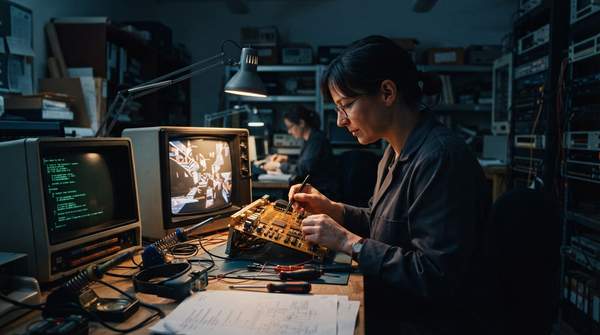
Digital art cannot be preserved the way a canvas or a bronze can. When a work exists as software running on hardware that will fail, conservators must choose among uncomfortable options—migrating it to new formats, emulating its original environment, or letting later re-installations differ from the first—and every option touches the artwork's authenticity. The result is a genuine ethical conflict: the traditional conservator's duty of minimal intervention and material fidelity now collides with the practical reality that a digital work survives only through constant change. What conservators must balance, increasingly with the artist's help, is the artwork's intent against its original material—two things that traditional ethics treated as one.
The Shifting Landscape of Art Conservation
Classical conservation ethics grew from stable, physical objects. Cesare Brandi's influential theory held that restoration should serve the artist's intent and the work's aesthetic experience without altering original material, that interventions should be reversible and distinguishable to the trained eye, and that the conservator should intervene only minimally, letting the artwork show its age. As Brandi put it, "restoration should aim to re-establish the potential oneness of the work of art, as long as this is possible without committing artistic or historical forgery, and without erasing every trace of the passage through time of the work of art."
Old Master practice, accordingly, focuses on slowing degradation while respecting patina and preserving the work's visual unity. The twentieth century strained these principles. Rhiannon Piper, a conservator writing on the challenges of twentieth-century artworks, describes how minimal intervention and reversibility were challenged by modern and contemporary art, forcing conservators into more invasive treatments and into heated professional debates about how far the conservator may intervene in an artwork's natural aging.
Computer-based art pushes the same tension to a breaking point. Writing in the Electronic Media Review on computer-based installations, one observer notes that over the past three decades there has been a radical change in technological borderlines and display standards, that preserving these works owes much to time-based media research, and that their conservation "distinguishes itself from conventional approaches to traditional media"—with little institutional expertise yet devoted to the problem.
Digital Art's Unique Properties: Obsolescence, Variability, and Dematerialization
Three properties make computer-based art a different ethical case from its physical ancestors. The first is technological dependency: the work is software and data that require functioning hardware, operating systems, and display equipment, all of which become obsolete. A painting's support ages; a digital artwork's support disappears from the market. Keeping the work accessible means, at some point, changing its technical substrate—precisely what traditional ethics forbids.
The second is variability. Unlike a painting, whose authentic state is a single physical object, a digital installation may be re-installed on different equipment, at different scales, in different galleries, and each instance can be a legitimate presentation of the work. Amy Brost, writing on reconciling authenticity and reenactment in time-based media, observes that this variability explains real museum behavior—why one institution keeps specific televisions for one video work but not for another, or why one film-originated work must be shown on a projector while another may be shown on a screen. The work is not one fixed artifact; it is a set of permissible performances.
The third is dematerialization. The "object" worth protecting may be a concept, a script, or an intended experience rather than a physical thing at all. Brost draws on the distinction between autographic works—singular physical objects that can be forged—and allographic ones, like musical scores, whose authenticity lies in faithful performance. Time-based media seem allographic, she notes, yet lack any standard notation system, which leaves the work's identity distributed across equipment, code, and documentation rather than secured in a master artifact.
Redefining Authenticity: From Material to Experience and Intent
These properties force a redefinition of authenticity. In traditional practice, authenticity attaches to original material and historical patina; the conservator's honesty lies in making interventions detectable. For digital works, that definition breaks down, because the original material will inevitably be replaced. The authenticity worth preserving shifts instead to conceptual integrity, performative fidelity, and the experience the artist intended.
A panel convened by VoCA on authenticity in installation art framed the open questions directly: whether new terminologies could advance the discussion of authenticity in conceptual art, whether artist intent is a valid factor in treating a particular iteration as authentic, and where the boundaries of obligation fall for institution, conservator, curator, and viewer. Notably, the panel did not settle these questions—artist intent's status as an authenticity criterion remains a live debate among practitioners such as Brian Castriota, Chrissie Iles, Julie Reiss, and Glenn Wharton, rather than a settled rule.
Digital heritage scholarship points in a similar direction while preserving the classical virtue of transparency. Researchers at the Istituto per le Tecnologie Applicate ai Beni Culturali and co-authors, writing in a Springer volume on authenticity in digital heritage applications, argue that clearly distinguishing original from digitally generated parts prevents deception about a restoration and respects the original creator's intent by highlighting where interpretive decisions were made. The traceability principle survives; only the notion of an untouched original material substrate does not.
The Artist's Expanded Role and the Imperative of Documentation
If authenticity lies in intent and performance rather than in fixed material, the living artist becomes the decisive authority. Guidance published by the Digital Preservation Coalition on preserving digital art states this plainly: the artist's view is essential to understanding a work's conceptual elements and work-defining properties, and artists and their technical teams are usually best placed to explain its display and production techniques—information that must inform any preservation decision, for instance migration between media formats. The same guidance notes that artists must also grant permissions for specific uses, from gallery display to publishing images or recordings online.
Documentation therefore becomes the closest thing digital art has to Brandi's "original material." If there is no stable object to protect, the institution's ethical duty shifts toward recording what the artist considers work-defining: acceptable display conditions, permissible substitutions, forbidden changes, and the reasons behind them. Brost's museum examples confirm that conservators repeatedly interview artists for exactly this purpose, and that repeated installation and documentation figure prominently in these works' survival. The ethical weight of the conservator's decisions lands earlier than it used to—while the artist and the original equipment still exist.
Ethical Decision Framework for Digital Art Conservation
The framework below contrasts traditional conservation principles, which assume a stable physical object, with the demands computer-based art places on each principle. It is structured around the three dimensions that drive most preservation decisions for digital works: what counts as authentic, whose intent governs, and how far intervention may go.
| Conservation principle | Traditional art (physical objects) | Digital art (computer-based) |
|---|---|---|
| Authenticity | Authenticity rests on the physical integrity of original materials and their historical patina. This applies to stable, physical artworks. | Authenticity shifts to the work's conceptual integrity, performative aspects, artist's intention, or intended experience, rather than a fixed material form. This applies to variable, performative, or code-based digital artworks. |
| Artist's intent | Intent matters, but material preservation takes priority; interventions should be reversible and distinguishable from the original. | The artist's vision is critical and often dictates what counts as the authentic work, permitting variations across re-installations. This is especially true for conceptual or technology-dependent works. |
| Intervention | Minimal intervention preserves original material and patina; changes are ideally reversible and distinguishable. | Active management, reinterpretation, or migration is required because of technological obsolescence, making minimal intervention untenable. This is necessary to ensure the work's longevity and accessibility. |
Read as a decision aid, the matrix identifies where each choice costs something. Migrating a work to new formats preserves accessibility but severs the link to original material, so it is defensible only when documentation shows the artist treated the concept, not the substrate, as work-defining. Emulation preserves behavior while replacing every physical component, which is honest only if the original and emulated parts are clearly distinguished—precisely the transparency both Brandi's tradition and the digital heritage researchers demand. Reinstallation on contemporary equipment keeps the work alive but risks drifting from the artist's intent unless the artist's stated boundaries govern what may change.
These are not universal answers, and this article does not offer a technical guide to migration or emulation, nor legal advice on rights and contracts. Each decision remains institution-specific: the framework's value is in making the trade-offs explicit—accessibility versus material fidelity, transparency versus seamlessness, present-day artist authority versus future re-creators' judgment—before obsolescence forces a rushed choice.
Navigating the Future of Digital Art Preservation
Conservators must adopt a flexible, collaborative, and conceptually driven approach to digital art preservation, prioritizing artist intent and comprehensive documentation over strict material permanence. That is a genuine ethical pivot rather than a technical upgrade: it replaces the ideal of the untouched original with an ongoing, accountable practice of managed change. The measurable indicator to watch is the continued development and adoption of "variable media" strategies and artist-defined preservation guidelines by major institutions—the concrete sign that this shift from preserving objects to preserving intent is becoming standard professional practice.
Sources
- Preserving the Present — The Dedalus Foundation
- Conservation Challenges of 20th-Century Artworks — Rhiannon Piper Conservation Ltd.
- Versions, Variations, and Variability — Resources
- Authenticity in Installation Art - VoCA — Authenticity in Installation Art - VoCA | Voices in Contemporary Art
- Authenticity in the Design of Digital Heritage Applications — SpringerLink
- Dpconline