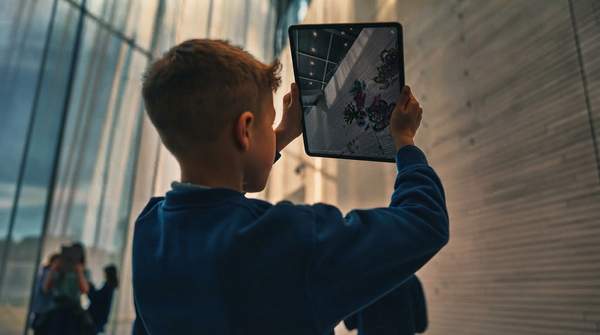
Contemporary AR and VR art rests on two conceptual pillars. The first is convergence: the merging of real and virtual space into a single hybrid environment, a term coined in a dissertation study of augmented reality art's "visual regime." The second is participant transformation: the redefinition of the viewer's role from passive observer to active participant, a shift identified in academic analyses of extended reality technologies in art. Understanding these two frameworks gives readers a working lens for almost any immersive artwork they encounter.
Introduction: Redefining Art with AR and VR
When augmented and virtual reality entered the studio and the gallery, they did more than add a new medium; they unsettled the basic contract between artwork and audience. A study of traditional-digital art collaboration published in a management journal argues that XR technologies are facilitating a fundamental reimagining of how art is experienced: paintings and sculptures are "no longer static objects for passive viewing but can become portals to immersive, interactive experiences." That study links the shift to contemporary art theory's emphasis on viewer participation and the dissolution of boundaries between artwork and audience.
Research on AR and VR in contemporary art performances, published by Assembek, Diachuk, Kunderevych, Yermolaieva and Sharypin in the journal Convergences, extends the point to institutional practice: the viewer is involved in the performative environment "not as a consumer, but as a participant in an artistic event." The two frameworks below organize what these technologies actually change—one targets the space of the artwork, the other targets the person standing in front of it.
Conceptual Framework 1: Real-Virtual Convergence
The dissertation study "The Visual Regime of Augmented Reality Art" defines AR as "a set of visualization and interaction systems that permit the perceptual overlay of virtual information (including photos, videos, 3D graphics, texts, sounds) on top of our material reality, in real time, site-specifically, and in an interactive manner." The definition is precise: the overlay is perceptual, real-time, site-specific and interactive—not a recorded image of a virtual world, but a live fusion.
From this definition the study derives its central concept: "AR's capacity to articulate a hybrid space that seamlessly merges real and virtual elements is what I call convergence." Convergence is thus a spatial claim. The artwork does not replace physical reality, as fully virtual environments tend to, but layers itself onto it, so that reality and virtuality become "not only adjacent but also perceptually convergent within the same space-image." The viewer's role under this framework is perceptual: their experience of physical space is altered by the integration of virtual elements into it.
Conceptual Framework 2: Participant Transformation
The second framework concerns not space but role. The Convergences study of AR/VR in art performances identifies the viewer's transformation from consumer into participant as a defining characteristic of these technologies, and proposes practical models for interactive museum exhibitions and digital art residencies built around that shift. The traditional-digital collaboration study reaches the same conclusion from the production side: the boundary between artwork and audience dissolves when the work requires the viewer's engagement to complete it.
The distinction matters analytically. A work could overlay virtual content onto a gallery wall while leaving the viewer essentially a spectator of the hybrid scene; another could demand that the viewer's actions constitute the work itself. The two frameworks often coexist in a single piece, but they answer different questions—one about where the art exists, the other about who completes it.
Conceptual Frameworks in AR/VR Art
The table below categorizes the two dominant conceptual approaches, distinguishing methods that overlay information onto reality from those that create participatory experiences.
| Conceptual Approach | Key Principle | Viewer's Role | Example Artwork |
|---|---|---|---|
| Real-Virtual Convergence | Virtual elements are perceptually overlaid onto material reality, merging real and virtual into a hybrid space | Experiences an altered perception of physical surroundings | Living-Room 2 (2007); The Golden Calf (1994); Artvertiser (2008) |
| Participant Transformation | The viewer's role is redefined from passive observer to active participant | Interacts with and completes the work | AR-based interactive digital poems |
The categorization follows the evidence directly: the convergence row is built on the dissertation's definition of AR and its named examples, while the participation row reflects the academic analyses of XR's effect on the viewer's role. A reader can use the two rows as a diagnostic: ask first whether the work's primary achievement is spatial fusion, then whether it demands engagement.
Artworks Illustrating Convergence
The dissertation study names a canon of early AR works that demonstrate convergence: Jan Torpus's Living-Room 2 (2007), Janet Cardiff and George Bures Miller's Conspiracy Theory (2003), Jeffrey Shaw's The Golden Calf (1994), Julian Oliver's Artvertiser (2008), and John Craig Freeman and Will Pappenheimer's Hans Richt AR (2013), alongside AR mobile applications such as Layar and Wikitude. The study identifies these as "relevant examples of the way in which AR makes reality and virtuality not only adjacent but also perceptually convergent within the same space-image."
These works span nearly two decades and diverse formats—installation, locative media, mobile application—yet share the structural move of the convergence framework: virtual content is anchored to specific physical sites or objects, so that the viewer's ordinary environment becomes the substrate of the artwork. The dissertation's guiding question, "to what extent does reality-virtuality convergence particularly affect a user's experience of space?", remains the productive one for analyzing them.
Artworks Illustrating Participant Transformation
For the participation framework, the evidence points to interactive AR-based digital poems, evaluated in a study published in a technology-education journal. Its system usability scale results show the work "achieved positive usability, audiences enjoyed the interaction with the artwork, and most people accepted AR-based digital poems." The study contrasts this with the traditional condition: "Typically, artists present their work using non-interactive visual media."
The finding is qualified: it rests on usability evaluation of a specific AR system artwork, not a survey of the field. But it demonstrates the participation framework in measurable terms—an artwork whose success is gauged by whether audiences enjoyed interacting with it. That is the operational difference between the frameworks: convergence is judged by the quality of the hybrid space produced, participation by the quality of the engagement elicited.
Navigating the Immersive Art Landscape
Art enthusiasts and creative professionals should analyze AR/VR artworks by identifying whether their primary conceptual goal is real-virtual convergence or participant transformation. The measurable indicator is whether the artwork's design and interaction mechanisms clearly emphasize either the blending of digital and physical realities or the active engagement required from the viewer. A work like The Golden Calf invites the first question—what happens to space when virtuality overlays it—while an interactive digital poem invites the second: what must the viewer do for the work to exist at all. Most ambitious immersive art will answer both, but knowing which question a piece prioritizes tells you what the artist is really testing.
Sources
- The Visual Regime of Augmented Reality Art: Space, Body, Technology, and the Real-Virtual Convergence — Art History Dissertations and Abstracts from North American Institutions
- Management POLAND
- Virtual And Augmented Reality in Contemporary Art Performances | Convergences - Journal of Research and Arts Education — Convergencias
- TOJET