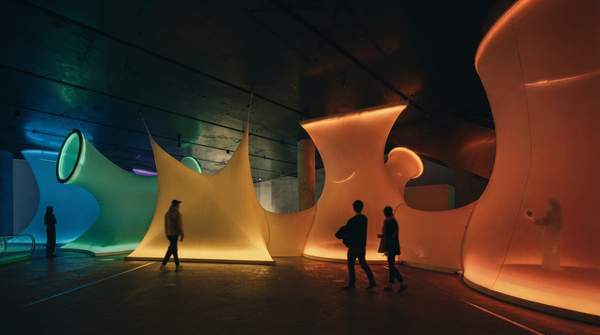
Augmented and virtual reality are dissolving one of the art world's oldest conventions: the expectation that visitors stand quietly at a respectful distance from the work. Contemporary exhibitions now deploy three distinct mechanisms—digital overlays on physical objects, full immersion in simulated environments, and installations that respond directly to the viewer's presence—and each one shifts the visitor from passive observer toward active participant. The change is measurable, it is being embraced by institutions such as the British Museum, the Met, the Smithsonian and Tate Modern, and it is redefining what a gallery visit means.
The Evolution of Art Engagement: From Passive to Participatory
The traditional gallery experience positioned the viewer as a consumer of finished objects: art hung on a wall, interpreted from afar, untouched. Research on virtual and augmented reality in contemporary art performances, published in 2026 in Convergences – Journal of Research and Arts Education by Assembek, Diachuk, Kunderevych, Yermolaieva and Sharypin, argues that these technologies overturn that arrangement, involving the viewer in the performative environment "not as a consumer, but as a participant in an artistic event."
Writing in the Journal of Theoretical and Applied Information Technology, researchers describe how VR in particular "redefines the viewer's journey, transforming abstract art into a fully immersive experience where interactivity and perception become central to the artwork's meaning." The artwork is no longer complete without the audience; meaning is produced in the encounter itself. This is not a marginal experimental current but a structural shift in how artists and institutions conceive the relationship between work and public.
A Framework for Digital Interaction in Art Exhibitions
Not all digital engagement works the same way, and the differences matter for what visitors actually experience. AR overlays digital content onto the physical world, blending realities; VR replaces the physical world with a simulated one; interactive installations use sensors and real-time systems so the artwork adapts to the viewer. The framework below classifies these experiences by their mechanism of interaction and the role each assigns to the visitor.
Digital Engagement Framework for Art Exhibitions
| Experience type | Mode of interaction | Viewer's role | Example / impact |
|---|---|---|---|
| Traditional viewing | Observation from a distance; no digital mediation | Passive observer, interpreting art remotely | The conventional gallery experience prior to digital integration |
| Augmented reality (AR) | Digital information overlaid onto physical objects or spaces | Informed observer, blending physical and digital realities | At the Pérez Art Museum Miami, the AR work 'Terrafish' invades the museum's hanging gardens with a 49-foot jellyfish-like structure, pulling viewers into a dialogue about climate change |
| Virtual reality (VR) | Full immersion in a simulated environment | Immersed explorer within a digital world | The British Museum's VR exploration of ancient Egypt, run daily in response to demand |
| Interactive digital installations | Direct interaction; the work adapts in real time to viewer input | Active, engaged participant in an artistic event | Per the Convergences study, the viewer becomes a participant in the performative environment rather than a consumer |
The framework's value is diagnostic: it lets a curator or visitor ask not simply "is there technology here?" but "what role does this technology assign to me?" AR's overlays invite participation and play, eroding the passive viewer role; VR's environments make perception itself central to meaning; interactive installations complete the arc, making the visitor's input part of the work.
Quantifying the Impact: Measurable Engagement in Digital Art
The claim that digital art is "more engaging" is often asserted rather than demonstrated. Quantitative research on AR and VR's impact on consumer behavior and engagement, based on feedback interviews, in-depth participant observation during AR/VR sessions, and structured surveys using 25 psychometrically validated items on five-point Likert scales, offers harder numbers. Using multiple regression, correlation and descriptive statistics, the study found that immersive experiences improved brand memory by 27 percent and increased dwell time by 38 percent, with a significant effect on purchasing confidence (β = 0.42, p < .01).
Qualitative results from the same research point to the psychological mechanism behind those figures: participants reported high levels of escapist experience (mean 4.3) and vivid mental imaging (mean 4.5), both correlated with higher emotional involvement. In gallery terms, that combination—longer dwell time plus deeper emotional investment—is precisely what curators seek when they measure whether an exhibition has genuinely reached its audience. The metrics come from consumer-behavior research rather than museum-specific trials, so they indicate a general effect of immersive design rather than a guaranteed outcome for every art installation.
Major Institutions Embrace Digital: A Mainstream Shift
What was once a "family day" gimmick has moved to center stage. The Smithsonian, Tate Modern and the Met have launched AR-driven exhibitions in which digital overlays reanimate historical objects, offer multilingual guides, or let visitors "see" lost works restored virtually, as MoMAA's editorial team has reported. The best institutions, that account argues, treat this not as entertainment but as a way to make collections radically more accessible to audiences who might never have entered a traditional gallery.
The British Museum offers the most vivid evidence of public appetite. Writing for the Arts Management and Technology Laboratory, Yasmin Foqahaa reports that Emily Smith, the museum's head of audience development, said the museum has "increased the number of slots and [is] now running the experience daily in response to demand. Visitors have even been bursting into spontaneous applause at the end of the showings." The Metropolitan Museum, meanwhile, has used VR on its website for 360-degree tours of the main six rooms of its American Wing. Artists themselves have followed: in June 2015, a group of artists hosted the first virtual art exhibition in San Francisco, the Tilt Brush Exhibition. When daily scheduling replaces pilot slots, digital programming has ceased to be an experiment.
Embracing the Active Viewer: A New Era for Art
Art institutions should continue to invest in AR and VR technologies to foster deeper viewer engagement and redefine the gallery experience. The evidence supports the investment: measurable increases in dwell time and memory, and audiences who respond with spontaneous applause. The measurable indicator to watch is increased visitor dwell time and positive feedback (e.g., applause, satisfaction scores) for digitally enhanced exhibitions. A museum that tracks those two signals across its digital and conventional shows will know, within a season, whether the shift from spectator to participant is working—and by how much.
Sources
- Virtual And Augmented Reality in Contemporary Art Performances | Convergences - Journal of Research and Arts Education — Convergencias
- Academia
- Augmented Reality in Art: Blurring the Line Between Physical and Digital — MoMAA | Affordable Art Gallery & Lifestyle
- Virtual Reality and Audience Engagement in Museums — Arts Management and Technology Lab