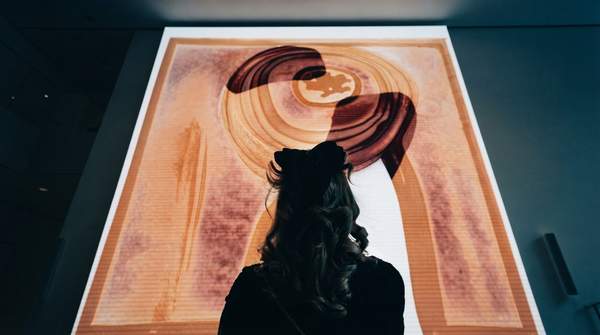
Artificial intelligence has not made the artist obsolete, and the debates it has triggered—about authorship, creativity, and the value of human intention—are best understood through a historical lens rather than a crisis narrative. The clearest way to grasp the current moment is to recognize that contemporary artists are engaging with AI in three distinct conceptual stances: as a practical tool, as a creative collaborator, and as a subject of critical inquiry. This framework, drawn from academic and institutional accounts of artists' working practices, offers more analytical purchase than a simple threat-versus-opportunity story.
Introduction: AI's Challenge to Art and Creativity
Generative AI has unsettled the art world along two opposing lines at once. An a2ru webinar framing on the topic, which brings together scholars of AI and the arts, including a University of Florida assistant professor of AI and the arts, captures the double edge: on one side sits "the automation of creative work, extraction of artists' content without consent, and deepening inequalities that marginalize already vulnerable creators"; on the other, "new tools for experimentation, expanded forms of collaboration, and evolving definitions of artistic agency opening new horizons for creativity."
The conceptual challenge, in other words, is not simply whether machines can make images. It is whether the category of the artist survives the arrival of a technology that can generate nearly finished products from a prompt, and what remains distinctively human—intention, meaning, interpretation—when that capacity exists. Those questions now structure nearly every public conversation about AI-assisted art, and they have prompted scholars to look backward as well as forward.
A Historical Lens: Photography's Parallel to AI in Art
The most instructive precedent for AI's arrival is the invention of photography in the nineteenth century. As the UNESCO Courier observes, citing professor Ahmed Elgammal—a researcher known for his own AI art project, AICAN—"the advent of photography was similarly perceived as a threat to artistic expression in the 19th century. Yet it spurred new movements and gained recognition as an art form itself."
The parallel is suggestive rather than exact: AI and photography are radically different technologies, and the comparison points to a recurring pattern of technological shock prompting artistic re-evaluation, not a one-to-one equivalence. But the pattern matters. Photography freed painters from the obligation to reproduce reality, and that release opened the door to new artistic movements; the Courier's argument is that AI "may free a new generation of artists from the constraints of the physical world" in a comparable way. The deeper continuity lies in the artist's role itself. As that analysis concludes, "it's artists who make art. The difference lies in intention, meaning, and interpretation," and it "takes human creativity to turn AI outputs into something that resonates on an emotional or cultural level."
Understanding Artistic Engagement with AI
The three modes below offer a diagnostic framework: when you encounter a new AI-assisted work, ask what relationship the artist has established with the technology, and the work's conceptual stance becomes legible. The categories describe primary approaches rather than sealed silos—artists may work across several at once.
| Mode | Artist's role | AI's function | Conceptual outcome |
|---|---|---|---|
| AI as tool | Directs and refines output to serve specific practical needs | Digital assistant for ideation, research, drafting statements, generating initial concepts | Efficiency and augmentation; AI as utility, not co-creator |
| AI as collaborator | Guides and responds to AI-generated elements in dialogue | Actively generates content, forms, or ideas the artist curates and integrates | Emergent aesthetics of human–machine interaction; singular authorship blurred |
| AI as subject of critique | Turns the technology into the artwork's central theme or medium | Automation, consent, inequality, and creative agency made visible as content | Conceptual commentary that interrogates AI's own existence and influence |
The tool mode is documented in Emma Duester's 2024 scholarly study of the contemporary art sector in China, which found artists using AI "in combination with other digital software to create ideas, research, exhibition proposals, and as part of their digital art work"—everyday labor that had previously been overlooked. A USC Scribe analysis adds that many artists are optimistic about using such programs "to find inspiration or quickly try out several iterations of an idea," though it cautions that use is unlikely to remain confined to ideation given these programs' capacity to generate near-finished products.
The collaborative mode extends that caution into a positive claim about authorship: when AI's contribution becomes significant enough to be part of the creative process rather than mere utility, the resulting work is a product of human–machine interaction, and questions about the nature of creative agency move from the margins of the discussion to its center. The critical mode, finally, takes the very anxieties catalogued above—automation of creative work, extraction without consent, deepening inequality—and makes them the subject matter of art itself.
The Human Element: Psychological Bias in AI Art Perception
Any account of AI art's reception must contend with a documented bias in the audience, not just the makers. The USC Scribe analysis reports that the disturbance AI models pose to people's worldviews would, according to psychological research, lead to a bias against AI-generated work—"a phenomenon that has in fact been repeatedly observed." The most striking evidence it cites is a peer-reviewed study in which, across four experiments and two different mediums, participants consistently rated works labeled as "AI-generated" lower in experienced awe than those labeled "human made," regardless of the actual method of generation.
The implication is sobering for how the current debates unfold. If the label alone diminishes the felt power of a work, independent of how the work was actually made, then public judgment of AI-assisted art is partly measuring the viewer's preconceptions about the creative source rather than the object in front of them. That bias does not settle the philosophical questions about authorship—those remain genuine—but it complicates any confident claim that audiences can presently evaluate AI-assisted art on its merits, and it suggests that the gallery public is itself an active participant in constructing the meaning of machine-made images.
Navigating the Evolving Landscape of AI Art
Culturally curious individuals and artists should approach AI art with an understanding of its historical parallels and the diverse conceptual intentions of artists, moving beyond initial biases. The photography precedent counsels patience with a technology still in its earliest artistic assimilation; the three-mode framework counsels precision, distinguishing the artist who uses AI as a studio assistant from the one who builds a genuine dialogue with the machine or turns the machine itself into the subject of critique; and the awe-labeling experiments counsel humility about our own first reactions. The measurable indicator to watch is the continued emergence of new AI-assisted artworks and ongoing public discourse regarding their authorship and creative merit—each new work a fresh test of whether audiences, and artists, can see the intention, meaning, and interpretation that the humans involved bring to the exchange.