Because most film and television productions are shot out of sequence, continuity is not preserved by memory but by documentation, and the person responsible for that documentation is the script supervisor. As Grace Smith explains in the Missouri Film Office's production jobs guide, shots that sit seconds apart in the finished cut may be filmed on entirely different days, so a crew member must track which hand held the coffee cup last week and at what angle the paper sat on the desk the day before.
The script supervisor's job, in Smith's description, is to maintain the continuity of a film, television, or commercial project with regard to everything on screen, and their notes become the record that allows the editor to cut the scenes together in the order the shooting script specifies. What follows is a phase-by-phase model of that workflow.
The Essential Role of a Script Supervisor in Film and TV Production
The role exists because of a structural problem in filmmaking: post-production arrives too late to fix a missed detail. Toronto Film School's guide on the position warns that because productions are shot out of sequence, "missing even a small detail is enough to ruin a scene," and once the film reaches post-production the problem can no longer be repaired. The script supervisor therefore works as a preventive instrument rather than a corrective one.
The scope of the position is unusually cross-departmental. Wikipedia's overview describes the script supervisor as a department head who acts as "the editor's and writer's representative on set," as well as a right-hand aide to the director and director of photography, tasked with making sure the film can be cut together after shooting concludes. The same source assigns them responsibility for monitoring camera shots so that dialogue and action match the corresponding pages of the shooting script. ScreenSkills' job profile frames the underlying aptitudes: analysis, observation, an "eagle eye," stamina across long filming days, meticulous note-taking, and communication with the director, actors, crew, hair, make-up, and production about continuity issues.
Pre-Production: Laying the Groundwork for Continuity
The work begins before cameras roll. Toronto Film School notes that the script supervisor starts in pre-production by preparing what is known as a Continuity Breakdown based on the script. StudioBinder's guide to the role makes the same point: the preparation done ahead of time ensures a smoother job once on set.
That preparation starts with a script breakdown, which StudioBinder defines as the filmmaking process used to identify all script elements needed to prep, schedule, and budget a production, determining the technical and creative requirements for each department. Grand Canyon University's explainer details what the supervisor's version contains: a document listing the various elements of each scene, which might include the time of day, the costumes needed, and the props required. The breakdown is then distributed to the relevant departments, such as costume, so that every unit knows what each scene demands before it is scheduled and shot. ScreenSkills likewise lists "break down, time and itemise scenes in terms of set, costumes, make-up, props and dialogue" among the supervisor's core analytical duties.
On-Set Production: The Eye of Detail
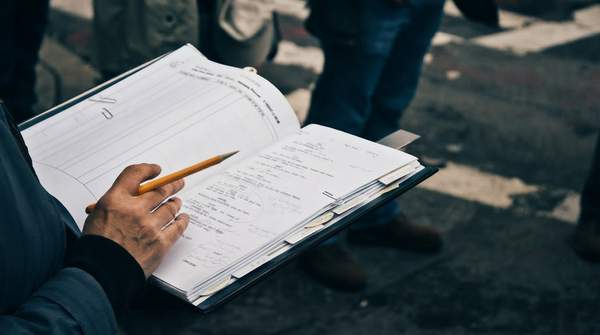
During shooting, the supervisor is present for each take, in Grand Canyon University's description, taking detailed notes. ScreenSkills emphasizes that these notes must be precise, quick, and efficient, and that the supervisor must communicate continuity issues to the director, actors, and every relevant department as they arise. Wikipedia adds a second, parallel duty: keeping track of the production unit's daily progress, which is why the position generates a daily report in addition to its running continuity notes.
The on-set function is fundamentally one of matching. The supervisor checks that the dialogue and action captured on camera correspond to the shooting script's pages, and works with camera, lighting, sound, wardrobe, make-up, properties, and sets, as Wikipedia's responsibilities section puts it, to make sure continuity errors do not happen. StudioBinder's account of resetting between setups captures the practical stakes: the notes exist so that every department can know where everything was originally placed before a reset or a new camera setup.
The Script Supervisor's Workflow: A Phase-by-Phase Model
The clearest way to see the job is as a chronology in which each phase produces the documents the next phase depends on. Pre-production analysis creates the breakdown; the breakdown informs on-set vigilance; on-set notes become the editor's raw material.
| Phase | Key Tasks | Primary Documents/Outputs | Continuity Focus |
|---|---|---|---|
| Pre-Production | Analyze the script; break down, time, and itemize each scene | Continuity Breakdown or Script Breakdown detailing each scene's requirements, including time of day, costumes, and props; sent to departments such as costume | Establishes the reference state every later phase is checked against |
| On-Set Production | Attend every take; monitor that dialogue and action match the shooting script's pages; work with camera, lighting, sound, wardrobe, make-up, properties, and sets; keep departments informed of continuity issues | Per-take continuity notes recording details needed to re-create a scene; daily reports on the production unit's progress | Consistency of props, wardrobe, hair, make-up, set dressing, and actor actions across takes |
| Post-Production | Act as the editor's and writer's representative; support cutting scenes together in script order | Shooting notes handed to the editor, enabling the film to be compiled smoothly | Narrative flow: shots matching so the story reads as intended |
Read down the middle columns and the information flow becomes explicit: the breakdown defines what must stay consistent, the on-set notes record whether it did, and the editor's notes ensure that record reaches the cutting room in usable form. Remove any phase and the chain breaks—without the breakdown there is no reference state; without the notes there is no evidence; without the handoff there is no seamless assembly.
Post-Production: Guiding the Edit
The supervisor's notes are not archival; they are working documents for the cutting room. Wikipedia states plainly that the notes recorded during the shooting of a scene are used to help the editor cut the scenes together in the order specified in the shooting script, and that it is the supervisor's job to make sure the film can be cut together once shooting concludes. Grand Canyon University's explainer echoes this, positioning the supervisor's documentation as the bridge between set and edit. In this sense the departmental work of production—wardrobe resets, prop placement, matched actor actions—only pays off if its record survives into post-production.
Key Categories of Continuity Monitored by a Script Supervisor
Smith's Missouri Film Office guide enumerates the categories directly: everything on screen, "including hair, makeup, wardrobe, props, set dressing, and the actions of the actors." ScreenSkills' profile extends the list to set, costumes, make-up, props, and dialogue, itemized according to where they fall in the story. Each category is a separate failure mode.
The stakes of a lapse are familiar to any cinephile. Smith cites two canonical examples: Dorothy's pigtails in The Wizard of Oz going from long to short and long again within seconds, and the notorious coffee cup in the final season of Game of Thrones. Both are cases where an on-screen object changed state between shots that the edit placed side by side—precisely the mismatch a supervisor's per-take notes exist to catch. Her account is candid that even professionals make mistakes: the job is difficult, and the categories are tracked rather than guaranteed. When a detail slips through, Toronto Film School's guide notes the consequence can reach beyond immersion, since a ruined scene cannot be fixed in post-production—implying the expensive remedy of reshooting.
Ensuring Seamless Storytelling: The Script Supervisor's Impact
Aspiring filmmakers and cinephiles should recognize the script supervisor as an indispensable role for maintaining narrative and visual integrity, directly impacting the final quality and cost-efficiency of a production. The measurable indicator is concrete: a film or television production that exhibits no noticeable continuity errors across scenes, even when shot out of sequence, indicates effective script supervision. The next time a scene cuts seamlessly between two shots filmed days apart—the cup in the same hand, the paper at the same angle—the credit belongs, in significant part, to the supervisor whose breakdown, notes, and editor's reports made that invisible continuity possible.